
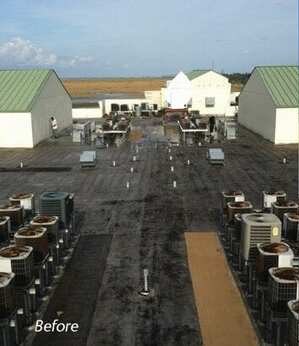
For older commercial buildings
Your roof is old. That does not mean it needs replacing
Most aging commercial roofs — 15, 20, even 30 years old — can be restored with a coating system for a fraction of replacement cost, as long as the deck is sound and the insulation is dry.
- 15, 20 and 30-year-old roofs
- No tear-off
- Fresh 10/15/20-year warranty
- Licensed CCC1327130
Last updated
The question every older building eventually faces
Most older commercial roofs can be restored rather than replaced. The deciding factor is not the roof's age but the condition of the structural deck and the insulation beneath the membrane.
A commercial roof that has passed its warranty starts attracting replacement quotes. Tear-off, dispose, re-insulate, re-roof — weeks of work, a six-figure number, and a building that cannot operate normally while it happens.
That quote is often answering the wrong question. A roof reaching the end of its membrane life is not the same as a roof reaching the end of its structural life. On most commercial buildings the deck is steel or concrete and will outlast several membranes. If water has not yet reached the insulation, the existing roof is a substrate — and a fluid-applied coating turns that substrate into a new, seamless, warrantied membrane.
The cost difference is not marginal. Restoration typically runs 30–50% of a comparable tear-off and re-roof, because there is no demolition, no disposal, no insulation replacement and no exposed deck to protect overnight.
What an aging roof actually costs you
The expensive part of deferring is not the repairs. It is the moment the restoration window closes and the only remaining option is the capital project.
- Restoration cost versus full replacement
- 30–50%Restoration cost versus full replacement
- Service life a silicone system adds
- 15–20 yrService life a silicone system adds
- Age of a church roof we restored rather than replaced
- 26 yrAge of a church roof we restored rather than replaced
- Days an occupied building has to close
- 0Days an occupied building has to close
Still a candidate
When an old roof can be restored
- The structural deck is sound
- Insulation under the membrane is dry
- The membrane still holds a coating
- Leaks are at seams, flashings and penetrations
- The roof is 15, 20 or even 30 years old
- The original warranty has expired
- Repairs have become a recurring line item
- A replacement quote is unaffordable this year
Past the window
When we will tell you to replace
- Moisture surveys show saturated insulation
- The deck itself is failing or corroded through
- The membrane has deteriorated past bonding
- Shrinkage has pulled flashings off walls and curbs
- Structural movement the roof cannot absorb
- Storm damage that compromised the assembly
We would rather lose the coating job than sell you one that fails in three years. If the roof has gone, the inspection report says so.
By roof age
What we typically find
A rough guide to where a commercial roof sits in its life, and what that means for the decision in front of you.
| Roof age | What we usually see | Typical recommendation |
|---|---|---|
| 10–15 years | Surface wear, early seam movement, original warranty ending | Maintenance program, or coat early while prep costs are lowest |
| 15–20 years | Open seams, failed pitch pans, chalking, first real leaks | Prime restoration window — the lowest-cost point to reset service life |
| 20–30 years | Granule loss, brittle membrane, patch-on-patch history | Still restorable in most cases; inspection decides, not age |
| 30+ years | Multiple systems layered, unknown insulation condition | Moisture survey first; restoration if dry, replacement if not |
A guide, not a diagnosis. Roof age correlates with condition but does not determine it — a well-drained 25-year-old roof often outperforms a badly detailed 12-year-old one.
Common questions
Old roofs, answered
The questions owners and facility managers ask once a replacement quote lands on the desk.
Most older commercial roofs can be restored rather than replaced. The deciding factor is not the roof's age but the condition of the structural deck and the insulation beneath the membrane: if the deck is sound and the insulation is dry, a fluid-applied coating seals the existing roof and resets its service life for roughly 30–50% of replacement cost.
There is no age limit — we routinely restore roofs between twenty and thirty years old. A 26-year-old church roof with advanced granule loss was a successful restoration. What disqualifies a roof is saturated insulation, a failing deck, or a membrane too deteriorated for a coating to bond to, and all three are checked during the inspection before anything is proposed.
An expired warranty is the normal trigger for a restoration decision, not an emergency. You have three realistic options: keep making reactive repairs, replace the roof outright, or restore it with a coating system and take a fresh 10, 15 or 20-year leak-free warranty on labor and materials. Restoration is usually the cheapest of the three and the only one that does not take the building out of service.
Coating is substantially cheaper — typically 50–70% less than a full tear-off and replacement. The savings come from eliminating demolition labor, disposal fees and the insulation replacement a tear-off usually triggers, plus avoiding the business disruption of an open roof deck during work.
The restoration window closes. While the deck is sound and the insulation dry, a coating is an option. Once water gets into the insulation, the only remedy is tearing off and replacing the affected area, and the cost moves from a maintenance line item to a capital project. Deferring converts the cheapest fix into the most expensive one.
Next step
Find out which side of the line your roof is on
A free inspection tells you whether the roof can still be restored, what system it qualifies for, and what it costs — in writing. If it genuinely needs replacing, the report says that too.
Request an Aging Roof Assessment
Tell us the building's age, roof type and what you're seeing. Photos help.
Holding a replacement quote you cannot fund?
Get a second opinion before you commit the capital. Most older roofs have more life in them than the quote assumes.