
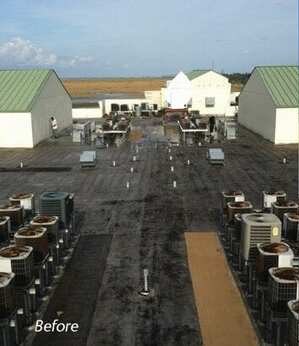
The problem
Water still standing on your roof days after the rain
Water on a commercial roof more than 48 hours after rainfall is ponding, not drainage — and most membrane warranties exclude the damage it causes. Silicone is the only common coating chemistry that survives it.
- 48-hour benchmark
- Warrantied over ponding
- Drainage corrected first
- Licensed CCC1327130
Last updated
What counts as ponding water
Water remaining on a commercial roof more than 48 hours after rainfall stops is classified as ponding rather than normal drainage. Most membrane manufacturers exclude ponding damage from their warranties, which means the failures it causes are the building owner's to fund.
In practice you do not need to time it. If you can see where the puddles sit on your roof from the staining and the dirt line they leave behind, you have ponding whether or not the roof is wet today. On a Florida commercial roof, those stains are usually the first thing visible from a satellite image.
Ponding matters more here than almost anywhere else in the country, for two reasons that compound each other: the rainfall arrives fast enough to overwhelm drainage designed for a gentler climate, and the sun that follows turns a shallow pool into a warm, biologically active one. A roof detail that would survive being wet for an hour in a drier state is submerged for days at a time here.
Consequences
What standing water actually does
Ponding rarely causes the leak directly. It takes every small defect the roof already had and turns it into a continuous water path.
It pressurises every defect
A pinhole in a seam that would never leak in a draining area becomes a continuous entry point under a standing head of water. This is why ponding areas account for a disproportionate share of the leaks on an aging roof.
It adds dead load to the deck
Water weighs a little over five pounds per square foot per inch of depth. A broad, shallow pond across a long-span deck is a real load the structure was not necessarily designed to carry permanently — and the deflection it causes deepens the pond.
It destroys the reflectivity you paid for
A white membrane was specified to reject solar load. Ponded areas hold dirt, algae and biofilm, go dark, and absorb heat instead. The roof stops doing the energy job it was chosen for.
It keeps the weakest details submerged
Water collects in the lowest part of the roof, which is where the drains, scuppers and the flashings around them live. The details with the most joints end up being the ones permanently underwater.
It re-emulsifies acrylic coatings
Acrylic and most elastomeric coatings soften and break down where water sits. A roof that ponds and was coated in acrylic will fail in the low spots first, regardless of how well the rest of the field performs.
It breeds mosquitoes and voids warranties
Standing water on a Florida roof is a mosquito habitat and, in some jurisdictions, a code issue. It is also an explicit exclusion in most single-ply and modified bitumen warranties, so the damage it causes is not covered.
Causes
Why your roof ponds
Usually two or three of these at once. On older buildings, deck deflection is the most common and the most often missed — because the roof drained correctly for twenty years before it stopped.
- Deck deflection developed over decades
- Inadequate slope designed in originally
- Blocked or undersized drains and scuppers
- Insulation compressed by foot traffic
- Wet insulation that has slumped
- Rooftop equipment added across a drainage path
- Crickets and tapered areas that have failed
- Overflow scuppers set too high
Honest limits
What a coating can and cannot do
A silicone coating makes ponding survivable. It does not make it go away. A 100% silicone membrane is warrantied over permanent standing water and will hold up in it indefinitely, which is the entire reason it is the default specification on Florida roofs that will not drain.
Where the low spots can be corrected, they are corrected first — tapered insulation crickets to redirect water, additional drains or scuppers where the roof needs more capacity, drains cleared and re-detailed. That work goes in before the coating, not after.
What no coating can do is re-slope a building. If the deck has deflected badly enough that water cannot be routed anywhere, we will say so, and the honest recommendation may be a tapered insulation system as part of a replacement rather than a restoration.
How we approach it
Drainage first, membrane second
Coating a ponding roof without addressing the drainage is how a 20-year warranty turns into a five-year roof.
- 1
Map the water, not the roof
We survey where water actually stands and how deep, read the staining, check every drain and scupper for capacity and blockage, and establish whether the low spots come from slope, deflection or crushed insulation. Moisture readings tell us whether water has already reached the insulation.
- 2
Correct what can be corrected
Tapered insulation crickets to move water toward drainage, additional drains or scuppers where capacity is short, wet insulation cut out and replaced, drains rebuilt and re-detailed. This is the part that determines whether the roof still ponds in year five.
- 3
Coat with a system warrantied for standing water
Details and seams reinforced with fabric, then a 100% silicone membrane at the manufacturer's specified mil thickness across the full field — with ponding water explicitly inside the warranty rather than excluded from it.
Common questions
Ponding water, answered
What owners ask once they realise the puddles are not going anywhere.
Yes. Standing water does not simply sit there — it adds dead load to the deck, keeps the membrane's weakest details permanently submerged, accelerates UV and chemical breakdown of the surface, grows biological material that holds moisture against the roof, and in Florida it breeds mosquitoes. Most importantly, it turns any small defect in a seam or flashing into a continuous leak path, because water under pressure finds its way through a pinhole that would never leak in a draining area.
The industry benchmark is 48 hours: water remaining on the roof more than two days after rainfall stops is classed as ponding rather than normal drainage, and most membrane manufacturers' warranties exclude it. In practice, if you can identify where the puddles are on your roof from the staining they leave behind, you have ponding whether or not it is wet today.
Four things, usually in combination: inadequate slope designed into the roof originally, deck deflection that has developed over decades so water no longer runs where it was sent, blocked or undersized drains and scuppers, and insulation that has compressed or gone wet and slumped. On older buildings deck deflection is the most common cause and the most often missed, because the roof drained correctly for twenty years before it stopped.
A coating makes ponding survivable rather than making it go away. A 100% silicone membrane is the only common coating chemistry that holds up indefinitely under permanent standing water — acrylics re-emulsify and soften where water sits. So silicone stops the ponding from destroying the roof, and where the low spots are correctable, tapered insulation crickets or additional drainage go in first as part of the work. What a coating cannot do is re-slope a building.
Usually deck deflection. Long-span steel and concrete decks settle gradually over decades, and drainage designed in 1985 no longer runs where the water now goes. Blocked drains and crushed insulation do the same thing faster. This is also why an old roof can suddenly start leaking in several places at once — new standing water finds every weak flashing and open lap on that part of the roof simultaneously.
Very often, yes. Most single-ply and modified bitumen manufacturers exclude damage from water standing longer than 48 hours, on the grounds that it is a drainage design issue rather than a membrane defect. It is worth reading your warranty before assuming you are covered for a leak in a ponding area. A silicone restoration system is warrantied with ponding water explicitly in scope, which is the practical reason it is specified on Florida roofs that will not drain.
Next step
Find out whether your roof can be drained or has to be sealed
A free inspection maps where water stands, whether it has reached the insulation, which low spots can be corrected with tapered insulation, and what the silicone system would cost. Photographs of the standing water are genuinely useful — but do not go onto a wet commercial roof to take them.
Not sure what assembly you have? Start with your roof type.
Request a Ponding Water Assessment
Tell us where the water stands and how long it takes to clear. Photos of the ponding areas help.
Told your roof cannot be coated because it ponds?
That is true of acrylic systems. It is not true of 100% silicone, which is warrantied over permanent standing water.