
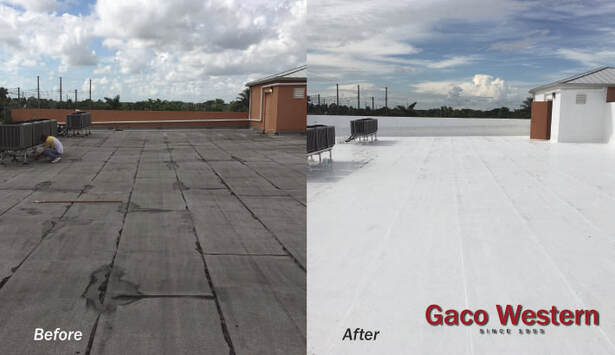
Roof type · Modified bitumen
Modified bitumen roof: coat it or replace it?
Modified bitumen is one of the best coating substrates there is: silicone bonds readily to weathered cap sheet, and a granulated ModBit roof that has lost its reflectivity can usually be restored for a fraction of replacement cost as long as the insulation is dry.
- Typical life: 15–20 years
- No tear-off
- 10/15/20-year warranty
- Licensed CCC1327130
Last updated
What a modified bitumen roof actually is
Modified bitumen is one of the best coating substrates there is: silicone bonds readily to weathered cap sheet, and a granulated ModBit roof that has lost its reflectivity can usually be restored for a fraction of replacement cost as long as the insulation is dry.
Modified bitumen is asphalt with a polymer modifier — SBS makes it flexible, APP makes it heat-resistant — rolled into sheets with a reinforcing mat and surfaced with mineral granules or a smooth film. It goes down in overlapping rolls that are torched, hot-mopped, cold-adhered or self-adhered, usually over a base sheet.
It is everywhere on Florida commercial buildings constructed or re-roofed from the 1980s through the 2000s, and it is the assembly most often sitting under a replacement quote right now. The granulated cap sheet weathers in a predictable, visible way, which makes ModBit unusually easy to assess honestly.
If your roof is dark, rolled in strips roughly three feet wide, and sheds what looks like coarse sand into the gutters, you have a modified bitumen roof.
- Typical service life
- 15–20 years, with granule loss visible well before the membrane itself fails
- Also called
- ModBit · Mod-bit · Torch-down roof · SBS / APP membrane · Rolled asphalt roof
Failure modes
How a modified bitumen roof fails
Every assembly fails in its own places. Knowing where yours gives out is what separates a restoration that lasts from a coating sprayed over a problem.
Granule loss and surface oxidation
The granules are the membrane's sunscreen. As they shed, UV reaches the asphalt directly and begins oxidizing it — the surface goes from pliable to grey, chalky and hard. This is the clock that runs on every ModBit roof in Florida, and it is why a 20-year roof here behaves like a 15-year roof.
Seam and lap separation
Every roll overlaps the next, and each lap is a bond that thermal movement works on twice a day. Laps lift at the edges, water gets under the sheet, and because the water now travels between plies it can emerge a long way from where it entered.
Blistering and ridging
Trapped moisture or air between plies expands in the heat and lifts the membrane into blisters. A blister is not itself a leak, but it is a thin, unsupported, UV-exposed spot that becomes one as soon as something steps on it.
Failed pitch pans and penetration details
ModBit roofs tend to be older roofs, and older roofs carry decades of accumulated rooftop equipment. The pitch pans around conduit and pipe supports dry out, shrink and crack. On most aging ModBit roofs we inspect, more active leaks trace to penetration details than to the field membrane.
Surface cracking and alligatoring
Oxidized asphalt loses the flexibility to absorb thermal movement, so it crazes into a pattern of fine interconnected cracks. Once that reaches through the cap sheet, the reinforcing mat starts taking water.
Why coating works here
The case for restoring it
Modified bitumen is the substrate coatings were practically made for. Weathered, granulated asphalt is a high-energy, textured surface, so a silicone system keys to it well — often with no primer at all. The coating replaces the lost granules with a far better reflective surface, seals the laps and penetration details that were leaking, and stops the oxidation clock dead. A ModBit roof with a dry deck and sound insulation is the strongest restoration case we see.
What we normally specify
GacoFlex S4200 or S20 100% silicone, typically direct to the weathered cap sheet
Silicone handles the two things that finish ModBit roofs in Florida: relentless UV and water that sits in the low spots for days after a storm. It also bonds to weathered asphalt readily enough that most ModBit roofs need no primer, which keeps the system cost down on exactly the buildings most likely to be funding this out of an operating budget.
When we will tell you to replace
What rules restoration out
Specific to this assembly — not a generic disclaimer. If the inspection finds any of these, the report says replace.
- Moisture survey shows widespread saturated insulation rather than isolated wet areas
- The membrane has alligatored through the reinforcing mat across the field
- Multiple layered roof systems of unknown and unverifiable condition
- Structural deck deterioration under the assembly
- Asphalt so badly oxidized it crumbles under hand pressure
We would rather lose the job than sell a system that fails in three years.
Preparation
What a modified bitumen roof needs before it is coated
Restoration is won or lost in the preparation. On this assembly, in this order — and a quote that skips a step here is quoting a different job.
- 1
Infrared or capacitance moisture survey
ModBit roofs are usually old enough to have taken water somewhere. The survey maps the wet areas so they can be cut out and replaced rather than sealed in, and it decides whether the roof is a restoration or a replacement before anyone commits.
- 2
Cut out and rebuild saturated areas
Wet insulation does not dry out under a coating. Affected sections are cut back to sound material, new insulation and cap sheet are let in flush, and the repair is tied into the surrounding roof.
- 3
Grind off ridges and open blisters
Blisters are cut, dried, re-adhered and patched. High ridges at laps are ground back so the finished surface does not leave a thin spot sitting proud of the field.
- 4
Rebuild pitch pans and penetration details
Old pitch pans are cleaned out and refilled, pipe boots replaced, and every penetration detailed with reinforcing fabric. On an aging ModBit roof this is where the actual leaks are, so this step is the job.
- 5
Pressure wash and let the surface dry fully
Decades of chalking and biological growth come off. Asphalt holds wash water longer than other substrates, so the roof has to read dry before coating — not merely look dry.
Proof
Modified bitumen roofs restored
Projects and GacoFlex system case histories on this assembly. Each page states who carried out the work.
ModBit Roof in Miami
Commercial building — modified bitumen roof
Owners were ready to tear off a badly patched mod-bit roof. A full GacoFlex S20 silicone system sealed it instead — epoxy primer, sealed pitch pans and drains, and a walkway system around the AC units.
System case historyWestin Hotel BUR / ModBit Roof
Hotel — built-up and modified bitumen roof
A 39,100 sq ft built-up and modified bitumen hotel roof taken through a full GacoFlex S20 system — a hospitality property restored without closing rooms.
Our projectSaving a Church Roof in Eatonville, FL
Church — administrative offices
A 26-year-old modified bitumen roof over the administrative offices of a church in Eatonville, FL had lost so many granules it was nearly smooth in places. A full tear-off was cost-prohibitive for the congregation, so a GacoFlex S4200 silicone system restored it instead — with services never interrupted.
Common questions
Modified bitumen roofs, answered
The questions owners and facility managers ask once a replacement quote lands on the desk.
Yes — ModBit is one of the best coating substrates there is. Weathered, granulated asphalt gives silicone a textured, high-energy surface to key into, so most modified bitumen roofs take a coating readily and many need no primer at all. The condition that matters is not the cap sheet but the insulation underneath: if a moisture survey comes back dry, a ModBit roof is a strong restoration candidate at 15, 20 or even 30 years old.
It means the clock has started, not that it has run out. The granules are the asphalt's UV protection, so once they shed, oxidation accelerates — the surface goes grey, chalky and stiff. But that is surface damage to a membrane whose reinforcing mat and plies are usually still intact. Granule loss is the signal to coat, and coating at that point is far cheaper than coating after the oxidation has crazed through the cap sheet.
Blisters are prepared, not coated over. Each one is cut open, dried, re-adhered and patched before any field coat goes down. Coating over a blister leaves a thin, unsupported spot in an otherwise sound membrane, and the first piece of foot traffic finds it. If a quote does not mention opening the blisters, it is not a restoration quote.
Torch-down describes how the roof was installed, not what it is made of — an APP modified bitumen sheet melted onto the substrate with a propane torch. So yes, a torch-down roof is a modified bitumen roof, and it restores the same way. The same goes for roofs described as mop-down, peel-and-stick or self-adhered rolled roofing.
Restoration typically runs 30–50% of a comparable tear-off and re-roof, because there is no demolition, no disposal, no insulation replacement and no exposed deck to protect overnight. The variables that move the number on a modified bitumen roof specifically are how much wet insulation has to be cut out and how many penetration details need rebuilding. Both are established by inspection, which is why we quote from a roof survey rather than a square-foot rate.
Next step
Find out where your modified bitumen roof stands
A free inspection tells you whether this roof can still be restored, what system it qualifies for, and what it costs — in writing. If it genuinely needs replacing, the report says that too.
Other roof types we restore
Request a Roof Assessment
Tell us the building's age, roof type and what you're seeing. Photos help.
Holding a replacement quote for a modified bitumen roof?
Get a second opinion before you commit the capital. Most aging commercial roofs have more life in them than the quote assumes.