
Roof type · Built-up (BUR)
Built-up roof: coat it or replace it?
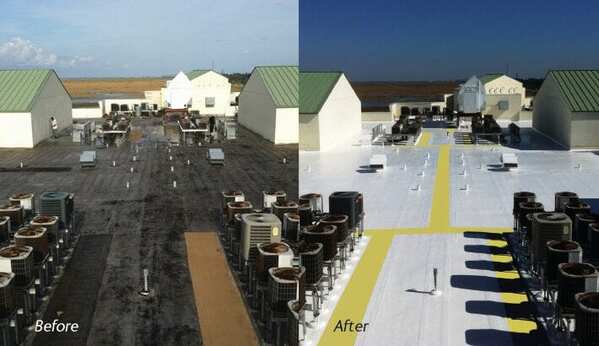
A built-up roof can be restored with a coating system once the gravel is removed or embedded and the plies are confirmed dry — and because BUR assemblies are thick and multi-ply, they often have more structural reserve left than their age suggests.
- Typical life: 20–30 years
- No tear-off
- 10/15/20-year warranty
- Licensed CCC1327130
Last updated
What a built-up roof actually is
A built-up roof can be restored with a coating system once the gravel is removed or embedded and the plies are confirmed dry — and because BUR assemblies are thick and multi-ply, they often have more structural reserve left than their age suggests.
A built-up roof is the oldest flat-roofing method still in service: alternating layers of bitumen and reinforcing felt, mopped down hot, three to five plies deep, then surfaced with gravel, a mineral cap sheet or an aluminum reflective coating. The gravel is not decoration — it is ballast and UV protection for the bitumen underneath.
On Florida commercial buildings, BUR is what you find on anything built or re-roofed before the 1990s, and on a surprising number of institutional, municipal and industrial buildings since. Many have had a second or third system laid over the original, which is why the first job on a BUR roof is often working out what is actually up there.
If your roof is covered in loose stone, or has a silver aluminized surface that chalks onto your hand, you are looking at a built-up roof.
- Typical service life
- 20–30 years, and often longer than the paperwork says because of the multi-ply build
- Also called
- BUR · Tar and gravel roof · Hot-mopped roof · Composition roof · Four-ply roof
Failure modes
How a built-up roof fails
Every assembly fails in its own places. Knowing where yours gives out is what separates a restoration that lasts from a coating sprayed over a problem.
Gravel displacement exposing bare bitumen
Wind, foot traffic and storm scour move the gravel around, and the bare patches it leaves behind take direct UV. Those exposed areas oxidize and crack years ahead of the protected field, so a gravel BUR fails in islands rather than uniformly.
Alligatoring of the bitumen surface
Exposed asphalt oxidizes, hardens and crazes into the interlocking crack pattern the trade calls alligatoring. On a BUR it is usually confined to the top ply at first — which is precisely why catching it early keeps the roof restorable.
Interply blistering and delamination
Moisture or air trapped between plies at installation expands in the heat, separating the layers. BUR blisters can be large and are sometimes decades old; they have to be opened and assessed rather than assumed sound.
Flashing failure at walls, curbs and gravel stops
The field of a BUR roof routinely outlasts its own flashings. Base flashings at parapets dry out and pull away, gravel stops rust and lift at the perimeter, and the metal edge details work loose. Most water entering an old BUR comes in at the perimeter, not through the field.
Ponding from decades of deck deflection
Long-span decks settle over thirty years, and drainage designed in 1985 no longer runs where the water now goes. Standing water on an aging BUR accelerates everything else and is often the reason a roof that was fine for decades starts leaking in several places at once.
Why coating works here
The case for restoring it
BUR assemblies carry real reserve: four plies of felt and bitumen is a thick, robust membrane, and the problem is almost always the top surface and the details rather than the body of the roof. A silicone system restores the surface the gravel was protecting, seals the flashings and perimeter details where the water is actually entering, and adds reflectivity to an assembly that was never designed to have any. The complication is the gravel, and it is a real one: it has to be removed, vacuumed or spud down to a bondable surface, and that is labor no quote can skip.
What we normally specify
GacoFlex S20 100% silicone over a prepared and primed BUR surface
Silicone is specified because aging BUR roofs almost always pond somewhere — three decades of deck deflection guarantees it — and silicone is the only common coating chemistry that holds up under water that never drains. Priming is more often needed here than on ModBit, because a spudded gravel surface and an aluminized surface behave very differently from weathered cap sheet.
When we will tell you to replace
What rules restoration out
Specific to this assembly — not a generic disclaimer. If the inspection finds any of these, the report says replace.
- Widespread saturated felts rather than isolated wet pockets
- Too many layered systems for the deck to carry, or for a coating to make sense over
- Structural deck corrosion or concrete spalling under the assembly
- Bitumen that has oxidized through multiple plies
- Ponding that cannot be corrected with tapered insulation or added drainage
We would rather lose the job than sell a system that fails in three years.
Preparation
What a built-up roof needs before it is coated
Restoration is won or lost in the preparation. On this assembly, in this order — and a quote that skips a step here is quoting a different job.
- 1
Core cuts to find out what is actually up there
Layered systems are the norm on old BUR. Test cuts establish how many systems, how thick, what condition each ply is in, and whether the assembly is still within the structural loading the building can carry. This also settles the question of whether another layer is legal.
- 2
Moisture survey across the whole assembly
Thirty-year-old multi-ply roofs hold water in pockets. The survey maps them, and the wet areas come out — a coating over wet felts seals in the water and fails.
- 3
Remove, vacuum or spud the gravel
Loose aggregate is vacuumed off and embedded gravel is spudded down until there is a continuous bondable surface. This is the step that makes BUR restoration more labor-intensive than ModBit, and the step a suspiciously cheap quote has left out.
- 4
Open blisters, cut out soft felts, rebuild flashings
Blisters are opened and assessed, deteriorated plies cut back to sound material, and base flashings at parapets, curbs and gravel stops rebuilt and reinforced. On an aging BUR this is where the leaks live.
- 5
Correct the drainage before coating it in
Where deck deflection has created ponding, tapered insulation crickets or additional drainage go in first. A coating that holds water is a coating with a shorter life than its warranty.
Proof
Built-up (BUR) roofs restored
Projects and GacoFlex system case histories on this assembly. Each page states who carried out the work.
Westin Hotel BUR / ModBit Roof
Hotel — built-up and modified bitumen roof
A 39,100 sq ft built-up and modified bitumen hotel roof taken through a full GacoFlex S20 system — a hospitality property restored without closing rooms.
System case historyGacoFlex S20 Silicone over a Metal Airport Roof
Airport hangar — metal and built-up roof
Ponding water was driving leaks across a 75,000 sq ft metal hangar roof. Recoating rather than replacing delivered a leak-free roof with a 10-year labor and materials warranty.
System case historyVacation Village, Florida
Resort property
A small silicone repair impressed the owner enough to commit the entire 23,600 sq ft roof to a full GacoFlex S20 system — the trial run sold the project.
Common questions
Built-up (BUR) roofs, answered
The questions owners and facility managers ask once a replacement quote lands on the desk.
Yes, but the gravel has to be dealt with first. Loose aggregate is vacuumed off and embedded gravel is spudded down until there is a continuous surface a coating can bond to. That preparation is genuine labor and it is the main reason BUR restoration costs more per square foot than coating a modified bitumen roof. Once the surface is prepared, a built-up roof restores well — four plies of felt and bitumen is a substantial membrane with real reserve left in it.
Not necessarily, and BUR is the assembly where age is least predictive. These roofs were built thick, and the failures we find are usually in the top ply and the flashings rather than through the whole build. What decides it is a moisture survey and a few core cuts: dry felts and a sound deck mean the roof is a candidate at 30 years, while saturated insulation means replacement at 15. We settle that before quoting, and the report tells you either way.
Alligatoring is the pattern of interlocking cracks that forms when exposed bitumen oxidizes and hardens — it looks like reptile skin. On its own it does not rule out restoration, because on a multi-ply BUR it typically starts in the top ply only. What rules it out is alligatoring that has opened through several plies into the felts, at which point water is already in the assembly and a coating would seal it in.
Usually drainage. Long-span decks deflect over decades, so water no longer runs where the 1985 design sent it, and it begins standing in new low spots. Standing water finds every weak flashing and open lap at the same time. That is why correcting drainage with tapered insulation or added drains comes before coating on these roofs, rather than after.
Sometimes, and it needs testing rather than assuming. Aluminized asphalt coatings chalk heavily as they age, and chalk is a bond breaker — so the surface has to be washed back to sound material and an adhesion test run on the result. Where the aluminized layer is thick, loose or heavily chalked, it comes off. This is a specific question our inspection answers for your roof rather than in general.
Next step
Find out where your built-up roof stands
A free inspection tells you whether this roof can still be restored, what system it qualifies for, and what it costs — in writing. If it genuinely needs replacing, the report says that too.
Other roof types we restore
Request a Roof Assessment
Tell us the building's age, roof type and what you're seeing. Photos help.
Holding a replacement quote for a built-up roof?
Get a second opinion before you commit the capital. Most aging commercial roofs have more life in them than the quote assumes.