
Roof type · Metal
Metal roof: coat it or replace it?
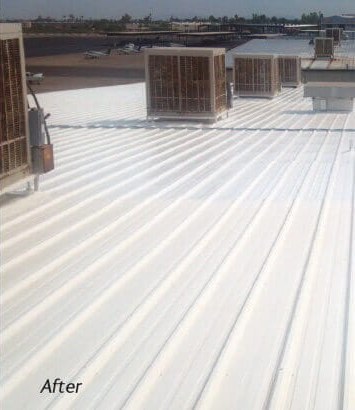
A metal commercial roof is restored by sealing its fasteners and seams and coating the panels — which stops the rust, eliminates the thousands of individual leak points a screw-down roof has by design, and avoids replacing panels that are usually still structurally sound.
- Typical life: 25–40 years for the panels
- No tear-off
- 10/15/20-year warranty
- Licensed CCC1327130
Last updated
What a metal roof actually is
A metal commercial roof is restored by sealing its fasteners and seams and coating the panels — which stops the rust, eliminates the thousands of individual leak points a screw-down roof has by design, and avoids replacing panels that are usually still structurally sound.
Commercial metal roofing comes in two families that behave very differently. A screw-down roof — corrugated, R-panel, 5V crimp — fastens the panels directly through to the purlins, so every screw is a hole through the roof sealed only by a rubber washer. A standing seam roof clips the panels to the structure and raises the joint above the water line, so it has far fewer exposures but relies on the seam and the clips to accommodate thermal movement.
Florida is hard on both. Salt-laden air drives galvanic corrosion, the daily thermal swing is large enough to work every fastener, and wind-driven rain gets at details that would stay dry in a drier climate. Metal roofs on warehouses, hangars, industrial buildings, agricultural structures and retail strips across the state are typically well past the point where their fastener washers have given up.
The useful thing about metal is that the panels and the failures are visible. You can usually tell from the ground whether a roof is rusting at the fasteners or at the laps.
- Typical service life
- 25–40 years for the panels, but only 10–15 for the fastener washers that seal them
- Also called
- Standing seam · Corrugated metal · R-panel · 5V crimp · Screw-down metal roof · Galvanized steel roof
Failure modes
How a metal roof fails
Every assembly fails in its own places. Knowing where yours gives out is what separates a restoration that lasts from a coating sprayed over a problem.
Fastener washers failing
This is the defining metal-roof failure. The neoprene washer under each screw head hardens, cracks and shrinks, and thermal cycling backs the screw out slightly. A screw-down roof can have tens of thousands of fasteners — so it does not develop a leak, it develops thousands of potential ones simultaneously.
Rust at panel laps, fasteners and cut edges
Corrosion starts where the protective coating was breached: around every fastener, along the side and end laps where water sits in the joint, and at every cut edge where bare steel was exposed. On coastal Florida buildings this is the clock that runs fastest.
Seam separation from thermal movement
Metal panels expand and contract significantly over a day. On a screw-down roof there is nowhere for that movement to go, so it works the laps apart. On standing seam, it works the seam closures and clips — and if the panels were ever fastened in a way that restricted movement, the metal oils-cans and the seams open.
Failed penetration and curb details
Pipe flashings, curb details and the sealant at ridge and eave closures are the shortest-lived parts of any metal roof. They are usually the first thing an owner tries to repair and the first thing to fail again.
Condensation on the underside
An uninsulated metal deck sweats. Occupants report a leak, nothing is found at the fasteners, and the water is actually condensation forming on the cold underside of the panel. A reflective coating reduces the panel temperature swing that drives it, but a persistent case is a ventilation and insulation problem, and we will say so.
Why coating works here
The case for restoring it
Coating a metal roof does something repair cannot: it makes the whole roof one surface. Every fastener head, every lap and every penetration is sealed and reinforced, then the field is coated — so the thousands of individual holes a screw-down roof depends on washers to seal simply stop being water paths. It arrests existing corrosion at the same time, and the reflective finish cuts panel temperatures sharply, which both reduces the thermal movement causing the damage and makes a measurable difference to cooling costs in an uninsulated building.
What we normally specify
GacoFlex silicone or acrylic, selected by exposure and drainage
Metal is the one assembly where we do not default to silicone. A sloped metal roof that drains freely and has no ponding is a good candidate for a reflective acrylic system — it costs less and performs well where water never stands, which is how we restored the Touch Tape roof in St. Augustine. Low-slope metal, anywhere water sits, or a roof with transitions into flat sections gets silicone, as on the Goodyear hangar. Slope and drainage decide, not preference.
When we will tell you to replace
What rules restoration out
Specific to this assembly — not a generic disclaimer. If the inspection finds any of these, the report says replace.
- Panels perforated through by corrosion, or rusted through at the purlin line
- Structural purlins or framing corroded past safe loading
- Panels oil-canning so severely that the seams can no longer be closed
- A roof whose reported leaks turn out to be an unresolved condensation problem
- Factory finishes still under a coating-incompatible manufacturer warranty worth keeping
We would rather lose the job than sell a system that fails in three years.
Preparation
What a metal roof needs before it is coated
Restoration is won or lost in the preparation. On this assembly, in this order — and a quote that skips a step here is quoting a different job.
- 1
Replace or tighten every failed fastener
Backed-out and spinning screws are replaced with oversized fasteners that bite into sound metal. There is no point coating over a fastener that is still moving. On a large screw-down roof this is the single biggest line item in the prep.
- 2
Treat the corrosion properly
Rust is wire-brushed or ground back to sound metal and spot-primed with a rust-inhibiting primer. Coating over active corrosion hides it for a season and then the rust lifts the coating off from underneath.
- 3
Pressure wash and remove chalking
Factory finishes chalk heavily after twenty years in Florida sun, and chalk is a bond breaker. The roof is washed until the surface stops transferring to a hand.
- 4
Seal fasteners, laps and penetrations with reinforcing tape or fabric
Each fastener head is sealed, and every side lap, end lap, ridge, eave and penetration is detailed with Gaco patching compound or reinforcing tape. This is where the leaks are, so this is where the system is won or lost.
- 5
Confirm the panels are worth coating
Where corrosion has perforated panels or eaten through at the purlin line, those panels are replaced before the system goes on. A coating bridges a pinhole; it does not bridge a hole you can see daylight through.
Proof
Metal roofs restored
Projects and GacoFlex system case histories on this assembly. Each page states who carried out the work.
T-MAKs Benefits from a New Silicone Roof
Commercial building — metal roof
A silicone coating applied straight over the existing metal roof — completed on time, within budget, and with minimal disruption to the business below.
Our projectTouch Tape, St. Augustine
Commercial building — corrugated metal roof
An aging corrugated metal roof with heavy oxidation, leaking fasteners and UV-degraded skylights — restored with a reflective acrylic system rather than replacing roof and skylights outright.
System case historyGacoFlex S20 Silicone over a Metal Airport Roof
Airport hangar — metal and built-up roof
Ponding water was driving leaks across a 75,000 sq ft metal hangar roof. Recoating rather than replacing delivered a leak-free roof with a 10-year labor and materials warranty.
Common questions
Metal roofs, answered
The questions owners and facility managers ask once a replacement quote lands on the desk.
Yes, provided the rust has not gone through the panel. Corrosion is wire-brushed or ground back to sound metal and spot-primed with a rust-inhibiting primer before anything else happens, which arrests it rather than hiding it. Where rust has perforated panels or eaten through at the purlin line, those panels are replaced first — a coating bridges a pinhole, not a hole you can see daylight through.
Because the screws were only ever sealed by a neoprene washer, and those washers have a shorter life than the panels. They harden, crack and shrink, and the daily thermal movement of the metal backs the screws out slightly. A screw-down roof can carry tens of thousands of fasteners, so it does not develop one leak — it develops thousands of potential ones at roughly the same time. That is why fastener replacement and sealing is the core of a metal restoration, not an extra.
Slope and drainage decide. A sloped metal roof that drains freely and never ponds is a good candidate for a reflective acrylic system, which costs less and performs well in that condition — that is what we specified on the Touch Tape corrugated roof in St. Augustine. Low-slope metal, any area where water stands, or a roof with transitions into flat sections needs silicone, because acrylic re-emulsifies under standing water. Metal is the one assembly where we genuinely specify both.
On an uninsulated or lightly insulated metal building the difference is noticeable, because you are changing the temperature of the ceiling itself. A bare or faded metal roof in Florida sun runs extremely hot and radiates that heat straight down into the space; a reflective white finish rejects most of the solar load instead. We will not quote you a percentage, because it depends on your insulation, your HVAC and how the building is used — but it is the one benefit metal-building owners consistently report back to us unprompted.
Yes, and the transition between them is the part that matters. Those junctions are where mismatched materials, different movement rates and awkward drainage meet, and they leak more often than either roof does. A single silicone system can run across both, which removes the transition detail as a separate point of failure. The Goodyear hangar was exactly this case — metal and built-up on one building, restored as one system.
Next step
Find out where your metal roof stands
A free inspection tells you whether this roof can still be restored, what system it qualifies for, and what it costs — in writing. If it genuinely needs replacing, the report says that too.
Other roof types we restore
Request a Roof Assessment
Tell us the building's age, roof type and what you're seeing. Photos help.
Holding a replacement quote for a metal roof?
Get a second opinion before you commit the capital. Most aging commercial roofs have more life in them than the quote assumes.