
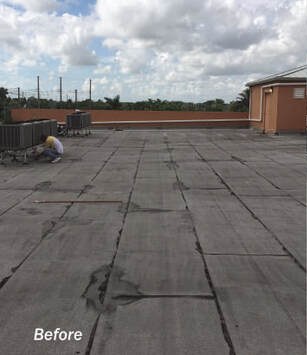
The problem
The leak is not where the stain is
Water enters a commercial roof at a detail, then travels — between plies, across the insulation, down a deck flute — before it finds the first gap in the ceiling below. Chasing the stain is why leaks come back.
- Leak diagnosis first
- Written condition report
- Repair or restore — honestly
- Licensed CCC1327130
Last updated
Why the source is so hard to find
Water almost never enters a commercial roof directly above where it appears inside. It gets through a defect, travels sideways between membrane plies, along the top of the insulation or down a deck flute, then emerges at the first gap it reaches — which can be twenty feet away.
That single fact explains most failed roof repairs. A contractor is shown a stained ceiling tile, goes up, seals the nearest thing that looks wrong, and the leak returns with the next storm — because the water was never coming from there. The stain is evidence, not a location.
Diagnosis works the other way round. It starts with the interior evidence — where the water appears, when it appears, and what the deck above it is made of — and uses that to work out which part of the roof could physically deliver water to that point. Then it goes to the roof and inspects the details in that zone properly, rather than inspecting whatever is directly overhead.
Where leaks really start
It is the details, not the field
On the aging commercial roofs we inspect, more active leaks trace back to penetration and perimeter details than to the membrane itself. Older buildings carry decades of accumulated rooftop equipment, and every piece of it is a hole in the roof.
Pitch pans
The sealed pockets around conduit, pipe supports and odd-shaped penetrations. The filler dries out, shrinks and cracks, and the pan becomes a funnel pointed straight into the assembly. On old roofs this is the single most common source we find.
Pipe boots and penetration flashings
Rubber and mastic details around vents, drains, condensate lines and electrical conduit. They have the shortest service life of anything on the roof and they are usually the first thing somebody has already tried to fix with sealant.
Base flashings at parapets and curbs
Where the roof turns up a wall or around a rooftop unit. Membrane shrinkage and thermal movement pull these details tight over years until they lift, split or pull away from the substrate entirely.
Seams and laps
Welded seams on TPO, overlapped laps on modified bitumen, glued or taped seams on EPDM. Every one of them is worked twice daily by thermal movement, and a lap that opens lets water travel between the plies rather than straight down.
Drains, scuppers and the gravel stop
Blocked drains make water stand against details until it finds a way through. Perimeter edge metal and gravel stops rust, lift and let wind-driven rain in behind the fascia, which reads as a leak well inside the building.
Fasteners, on metal roofs
A screw-down metal roof has tens of thousands of fasteners sealed only by neoprene washers. Those washers harden and shrink, and thermal cycling backs the screws out. The roof does not develop one leak — it develops thousands of candidates at once.
How we trace it
From the stain back to the source
The sequence matters. Starting on the roof and looking for something wrong will always find something — it will just not necessarily find your leak.
- 1
Start inside, with the timing
Where the water appears, what is above it, and crucially when. Leaks that follow rainfall are roof entry. Leaks that follow cool nights or humid mornings with no rain are usually condensation on a cold deck — a completely different problem with a completely different fix.
- 2
Establish the travel path
What the deck is made of decides how far water can move. A steel deck's flutes channel water lengthwise for long distances. Concrete holds it and releases it slowly. Insulation above the deck spreads it laterally. That tells us which zone of the roof to inspect, rather than which square foot.
- 3
Inspect the details in that zone, then report in writing
Every penetration, flashing, lap and drain in the candidate area, with moisture readings to establish whether water has already reached the insulation. You get a written condition report with photographs — which is also what an insurance adjuster will ask for if a storm is involved.
Repair
When a repair is the right answer
A single failed detail on an otherwise sound roof is a repair, and we quote it as one. We are not interested in selling a restoration to a roof that needs a pitch pan.
- One identifiable failed detail
- The membrane around it is in good condition
- Moisture readings come back dry
- The roof is still inside its warranty
- No history of repeat leaks in that area
- Storm damage to a specific, limited area
Restore
When repairing has become the expensive option
If repairs have become a recurring line item, each one is buying months on a membrane that has reached the end of its service life. At that point restoration costs less than the next three years of call-outs — and comes with a fresh warranty.
- Repairs have become a budget line
- The same areas keep coming back
- The original warranty has expired
- Leaks are appearing in several places at once
- Details are failing across the whole roof
- Patch-on-patch history with no clear record
Common questions
Roof leaks, answered
What facility managers ask while a bucket is still catching water.
Because water almost never enters directly above where it appears. On a flat commercial roof it gets through a defect, then travels — sideways between membrane plies, along the top of the insulation, down a deck flute, or across a steel joist — before it finds the first gap in the ceiling below. A stain on a ceiling tile can be ten or twenty feet from the actual entry point, which is why chasing the stain usually fails and why leak diagnosis starts at the roof's details rather than at the stain.
At the details, not in the field. On the aging commercial roofs we inspect, more active leaks trace back to penetration and perimeter details than to the membrane itself: dried-out pitch pans around conduit and pipe supports, failed pipe boots, base flashings pulling away from parapet walls, rusted gravel stops at the edge, open laps and seams, and blocked drains that force water to stand against a detail until it finds a way through.
It depends on whether the leak is an event or a symptom. A single failed detail on an otherwise sound roof is a repair, and we will quote it as one. But if repairs have become a recurring line item, if the roof is past its original warranty, and if the same areas keep coming back, each repair is buying months on a membrane that has reached the end of its service life. At that point restoration costs less than the next three years of repairs and resets the roof with a fresh warranty.
A temporary emergency measure can slow water entry in wet conditions, but no permanent repair or coating system can be installed onto a wet substrate — it will not bond, and sealing water into the assembly makes the situation worse. The honest sequence is to stabilise the immediate intrusion, let the roof dry, then diagnose and repair properly. Any contractor promising a permanent fix mid-storm is promising something the materials cannot do.
On a metal or uninsulated deck, check condensation before chasing the roof further. A cold panel underside in a humid building sweats, drips, and reads exactly like a leak — including showing up after cool nights rather than after rain. Timing is the tell: rain-driven leaks follow storms, condensation follows temperature swings. A reflective coating reduces the panel temperature swing that drives it, but a persistent case is a ventilation and insulation problem and we will tell you so rather than selling you a roof system.
Send us the details through the form and tell us what you are seeing and how long it has been happening — an active leak into an occupied building gets prioritised over a routine assessment. Photographs of the interior damage and, if it is safe to take them, of the roof area above it, let us arrive knowing what we are looking for. Do not go onto a wet commercial roof to get them.
Next step
Report the leak and we will trace it properly
Tell us where the water is appearing, when it started, and whether it follows rain or follows cool mornings — that last detail alone often changes the diagnosis. An active leak into an occupied building gets prioritised over a routine assessment.
Photographs of the interior damage help us arrive knowing what we are looking for. Do not go onto a wet commercial roof to take pictures.
Want to stop doing this every season? Maintenance programs catch these details before they leak.
Report a Roof Leak
Tell us where the water appears, when it started, and whether it follows rainfall. Interior photos help.
Had the same leak repaired more than once?
Then the repair was not the problem — the diagnosis was. Get the roof traced properly and find out what it actually needs.