
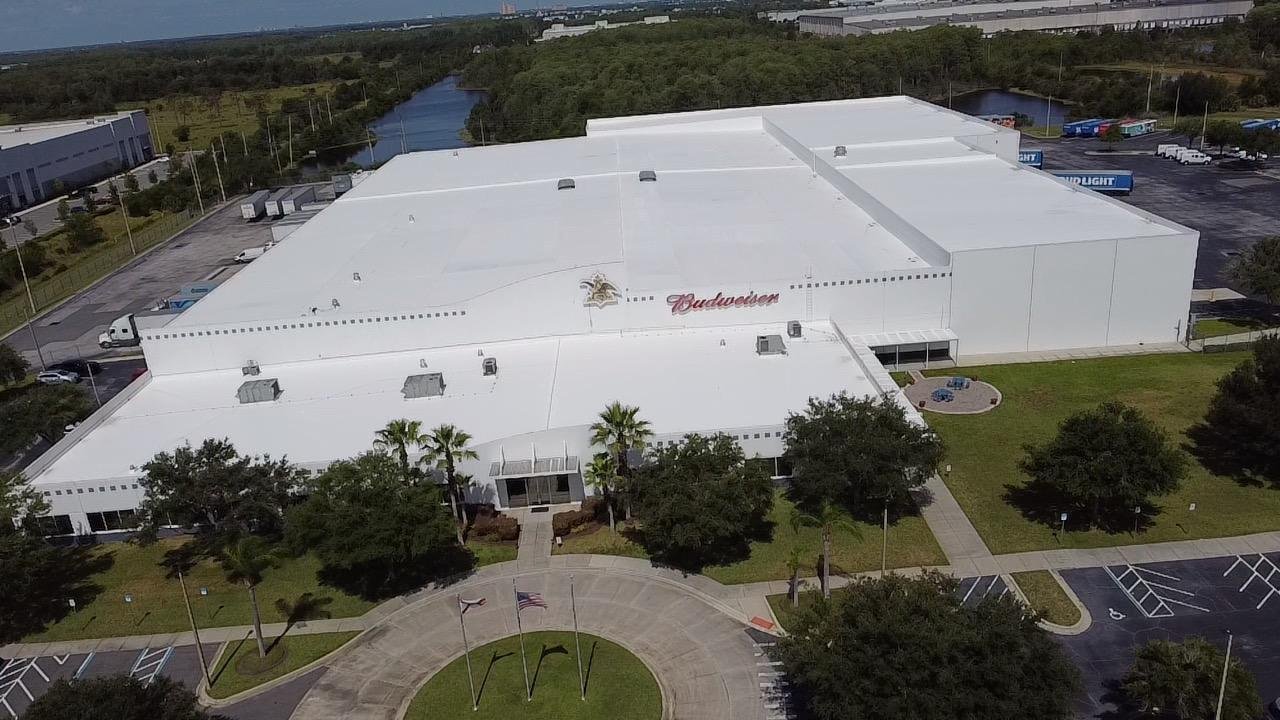
Roof type · TPO
TPO roof: coat it or replace it?
A TPO roof can be coated rather than replaced, and the deciding factor is the condition of the membrane's heat-welded seams and whether the sheet has any reinforcing scrim left above the fabric.
- Typical life: 15–20 years in Florida
- No tear-off
- 10/15/20-year warranty
- Licensed CCC1327130
Last updated
What a TPO roof actually is
A TPO roof can be coated rather than replaced, and the deciding factor is the condition of the membrane's heat-welded seams and whether the sheet has any reinforcing scrim left above the fabric.
TPO is a single-ply thermoplastic membrane — a thin reinforced sheet, usually white, either mechanically fastened through the insulation or fully adhered, with the sheets joined by hot-air welding rather than adhesive or tape.
It became the dominant commercial flat-roof membrane in Florida for a straightforward reason: it is white, so it reflects most of the solar load, and a welded seam is stronger than a glued one when it is made correctly. Most TPO on Florida buildings dates from the mid-2000s onward, which means a great deal of it is now reaching the point where the manufacturer's warranty has run out while the roof itself still looks serviceable.
That gap — warranty gone, membrane still largely intact — is exactly the window where coating makes the most financial sense and where tear-off quotes are hardest to justify.
- Typical service life
- 15–20 years in Florida, with the top ply weathering faster on unshaded roofs
- Also called
- Thermoplastic polyolefin · Single-ply white membrane · Thermoplastic single-ply
Failure modes
How a TPO roof fails
Every assembly fails in its own places. Knowing where yours gives out is what separates a restoration that lasts from a coating sprayed over a problem.
Seam welds opening
A TPO roof is only as good as its welds. Thermal cycling works at the weld line for years, and a weld that was run slightly cold on installation day will eventually separate. This is the single most common TPO failure and it rarely announces itself — water tracks sideways under the sheet and shows up at a ceiling tile ten feet away.
Scrim exposure from surface weathering
The sheet is a sandwich: a top weathering ply, a polyester reinforcing scrim, and a bottom ply. UV erodes the top ply from the day it goes down. Once you can see the woven scrim pattern through the surface, the weathering layer is effectively gone and the membrane can no longer be welded — which also means it can no longer be repaired conventionally.
Fastener-plate telegraphing and backing-out
On mechanically fastened TPO, every plate is a point load. Wind uplift cycles work the plates against the underside of the sheet, and over time you can see the fastener grid through the membrane. In the worst cases a fastener backs out and punches through from below.
Shrinkage pulling at perimeters and curbs
TPO shrinks slightly over its life. The field has nowhere to go, so the tension lands on the details — perimeter bars, curb flashings, pipe boots — and it pulls them tight until something splits.
Ponding at drains and crickets
TPO itself does not mind being wet, but ponding water holds dirt, kills the reflectivity it was chosen for, and keeps the seams in the lowest part of the roof permanently submerged. Ponding is the detail that most often turns a coatable TPO roof into an uncoatable one.
Why coating works here
The case for restoring it
A silicone coating over TPO solves the problem that TPO repair cannot: it does not care about the weld. Instead of trying to re-weld a sheet whose weathering ply has gone, the coating reinforces every seam and detail with fabric and mastic, then puts a single monolithic membrane across the whole field. The seams stop being the weak point because there are no longer any seams. The honest caveat is adhesion — TPO is a low-energy surface, so it needs a correctly specified primer and a genuine adhesion test, not an assumption.
What we normally specify
GacoFlex S4200 100% silicone, over a membrane-specific primer
Silicone is specified over TPO because the failure mode that ends most Florida TPO roofs is water standing on a seam, and silicone is the only common coating chemistry that is unbothered by permanent ponding. An acrylic over the same roof would re-emulsify in the low spots.
When we will tell you to replace
What rules restoration out
Specific to this assembly — not a generic disclaimer. If the inspection finds any of these, the report says replace.
- Scrim is exposed and fraying across large areas of the field
- Moisture readings show saturated insulation under the membrane
- Seams have opened widely enough that the sheet is no longer continuous
- Adhesion test patches fail on every primer option
- The membrane is a flexible PVC that has plasticized and gone brittle rather than TPO
We would rather lose the job than sell a system that fails in three years.
Preparation
What a TPO roof needs before it is coated
Restoration is won or lost in the preparation. On this assembly, in this order — and a quote that skips a step here is quoting a different job.
- 1
Adhesion test before anything else
TPO is the one substrate where we will not quote a system without a test patch. Formulations vary by manufacturer and year, and surface chemistry changes as the sheet weathers. We apply test patches, let them cure, and pull them. If they fail, the roof gets a different specification or a different recommendation.
- 2
Moisture survey through the insulation
Mechanically fastened TPO hides wet insulation well, because the sheet keeps looking fine while the board underneath is saturated. Coating over wet insulation traps the water and guarantees a failure, so this gets settled before the quote.
- 3
Pressure wash to remove the biofilm
An aging white membrane in Florida carries algae and a chalked surface layer. Both of those are a bond breaker. The roof is washed to a clean surface, not just a visually better one.
- 4
Primer specified to the membrane
The primer is selected from the adhesion test results, not from habit. This is the step most often skipped on a cheap TPO coating quote, and it is the step that determines whether the system is still bonded in year five.
- 5
Reinforce every weld, plate and detail
Seams, perimeter terminations, curb flashings, pipe penetrations and any telegraphing fastener plate are detailed with reinforcing fabric embedded in silicone before the field coat goes on.
Proof
TPO roofs restored
Projects and GacoFlex system case histories on this assembly. Each page states who carried out the work.
Common questions
TPO roofs, answered
The questions owners and facility managers ask once a replacement quote lands on the desk.
Yes, in most cases. A TPO roof is a good coating candidate while the reinforcing scrim is still covered by the weathering ply, the insulation beneath is dry, and the deck is sound. A silicone system reinforces the welded seams and details, then covers the field in a single seamless membrane — so the seams stop being the point of failure. The limiting factor is adhesion, which is why we test before quoting.
Two signs rule it out. If you can see the woven scrim pattern through the surface across the field, the weathering ply has eroded away and the sheet has no reserve left. If a moisture survey shows saturated insulation, coating would seal the water in. Either of those means replacement, and our inspection report says so in writing rather than selling you a system that will fail.
TPO is a low-surface-energy thermoplastic, which means coatings do not naturally key to it the way they do to a bitumen or a weathered metal surface. Formulations also differ between manufacturers and production years. We apply test patches, cure them, and pull them to select the primer — and if no primer bonds, we say so rather than coating it anyway.
No, and it is often the cheapest moment in the roof's life to act. Early leaks on a young TPO roof are almost always workmanship at the welds or details rather than the sheet wearing out, and prep costs are at their lowest while the membrane is still in good condition. Restoring early also resets the clock before the roof carries any new equipment — the City Beverage roof in Orlando was six years old when we restored it ahead of a 180,000 sq ft solar array.
It can, so this is worth checking before anything is specified. Most single-ply manufacturers treat an unapproved coating as a modification to the assembly. If there is meaningful warranty time left, we will tell you what it covers and what coating it would forfeit, and the new system carries its own 10, 15 or 20-year leak-free labor and material warranty in its place.
Next step
Find out where your TPO roof stands
A free inspection tells you whether this roof can still be restored, what system it qualifies for, and what it costs — in writing. If it genuinely needs replacing, the report says that too.
Other roof types we restore
Request a Roof Assessment
Tell us the building's age, roof type and what you're seeing. Photos help.
Holding a replacement quote for a TPO roof?
Get a second opinion before you commit the capital. Most aging commercial roofs have more life in them than the quote assumes.